Keyword Research (Google Keyword Planner)

Keyword Research (Google Keyword Planner)


Transcript Below:

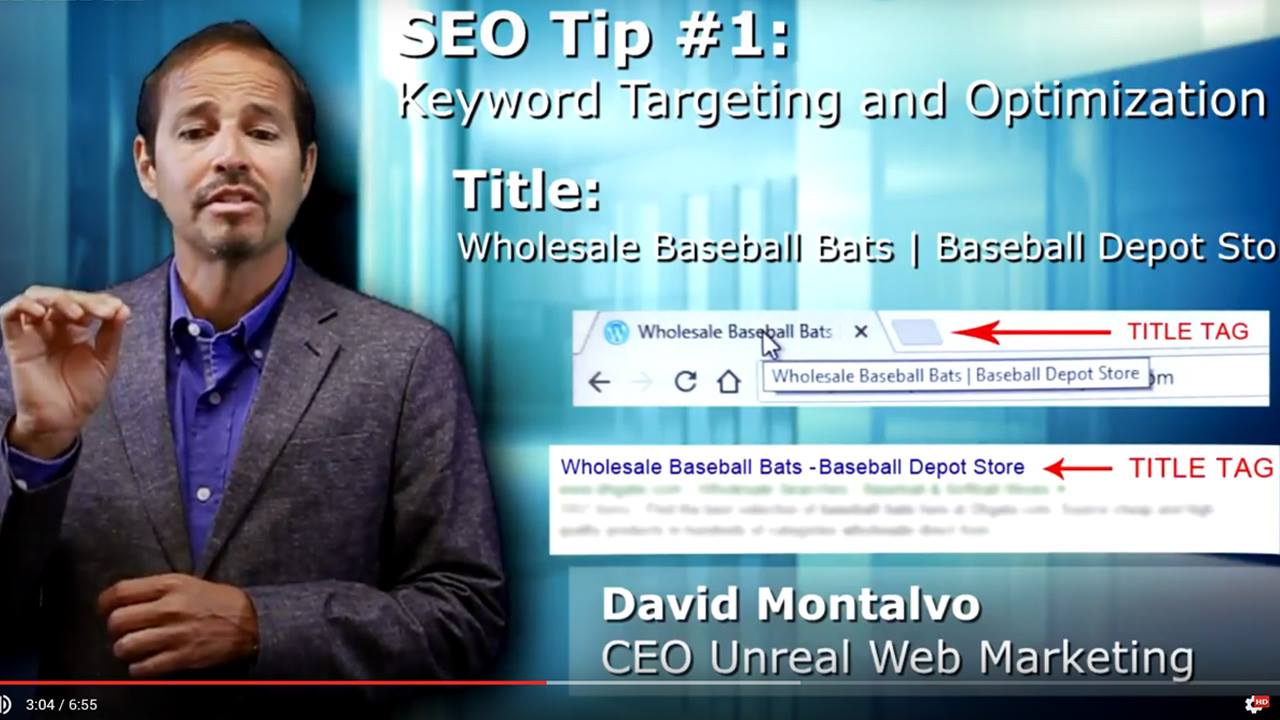
SEO Tip #1 Keyword targeting and optimization

Before any SEO implementation to your website pages, we first need to find the keywords or phrases you are going to target by using the Google Adwords keyword planner tool. This software will allow you to see how many searches are been done in the monthly basis for the services or products  you are offering. Once you have the list of terms or phrases you want to target , we are going to use the homepage to go after the most competitive phrase. Please keep in mind that some rankings can take up to 4 or 6 months to achieve, others can take longer. I  had an interesting experience with a client 5 years ago. We decided to go after a phrase that was getting 18,000 searches per month in Google, it took nearly 14 months to get a #2 ranking, but this phrase brought close to 7,000 visitors per month. This client sold a product that was going for $299 dollars, shopping cart conversion was 3%, monthly orders for that specific phrase, 210, that translated to $62,790 dollars just for one phrase. Not bad at all, right?

So keep that in mind when choosing the phrases you are targeting.  If you can afford to wait 10 to 12 months to get a competitive ranking, go for it.  But if time is a concern, optimize for less popular keywords, you will get less traffic but you will start getting orders in less than 60 days.

Now that we know which keywords we will be using for the homepage,  we are going to add this phrase to your homepage’s title tag. For this example, I will be using the phrase “baseball bats” which is very competitive as well as expensive if you were looking to purchase via Google adwords. So here it is:

Wholesale baseball bats | Baseball Depot Store

Did you notice that I didn’t place the main phrase “baseball bats” in the beginning of the title? This is because everyone out there going after the same keyword phrase already did that. So we need to try to be unique, different. You will get this ranking eventually as long as you have good quality content and plenty external links pointing to you. If you are running Wordpress and your website has an image slider functionality, make sure that the images are supporting your keyword phrase. So for this specific example, I will use the following names for my slider images:

adult-baseball-bats.jpeg

demarini-bats.jpeg

louisville-slugger-baseball-bats.jpeg

By doing this, we are adding our main phrase again to the page content, since is now part of the HTML/PHP code.

Please stay away from Flash. If you want a cool slider with transition effects and the ability to add TEXT, you can now accomplish this by using a jQuery plugin. The NIVO slider plugin is a good option since the packed version is only 15KB.

Now for the content we are going to use an H1 tag for the heading of the paragraph. In this case, let’s add our phrase again but also let’s include additional keywords that will support the main phrase and increase the page keyword density, Here we go:

Welcome to Baseball Depot – Adult and Children Bats

Or

Wholesale Baseball Bats by Baseball Depot

For the rest of the content, let’s add at least 800 words that will describe your product or service. Make sure to write for HUMANS and not the search engines. Your content has to be good to keep your visitors on your site for at least 25 seconds. This will help you lower your bounce rate which is an important metric in google analytics. Google uses this data to see if your content and website are relevant for the keyword we are targeting, the lower the bounce rate, the better chances you have to get a decent ranking.

Make sure to create “hyperlinks” within the home page content to your internal pages. Create links for your top categories, products or services. This will increase your internal link popularity and take some of that “link juice” or pagerank from the homepage and pass it to the other pages. This will also accelerate the indexing process.

If you have articles or testimonials, make sure to include them under this content and create hyperlinks for visitors to read the entire article or see the entire testimonials page. Use an H2 or H3 for the headings on these sections.

If you are running wordpress, make sure to add at least 3 columns to your footer using the widget tool and list your most important categories or services pages as well as your address, a Google map and business hours.

The last thing I want to mention on this TOPIC , is to try to keep your homepage under 2MB (megabytes) so that it loads faster for visitors as well as the search engines. Don’t forget to add your Marketing message or call to action, to the homepage. You need to tell your prospects, why are you the best or why they should buy from you.


Long Island SEO

Major Marketing Trends for 2020 and Beyond

Major Marketing Trends for 2020 and Beyond

With so many changes happening at such a high speed in digital marketing, most organizations are finding it challenging to keep up. As 2020 fast approaches, there are a few trends that are set to take the digital marketing world by storm.
Live Stream with Your Audience

Live video, or video streaming, allows you to broadcast a live video feed to an online audience. It’s like a live newscast, except anyone can do it and the audience can comment and react in real-time. Although live videos started trending in 2017, many businesses have still not adopted this interactive marketing channel to communicate with their audience. But according to Markets and Markets, live streaming will be worth an astonishing $70.05 billion by 2021.

Several social media platforms including Facebook, Instagram, YouTube, and Periscope now offer live video. You can often comment and react to live videos as they’re streaming. For example, while using Facebook Live, you can tap various reaction emoticons that will cause smaller versions of the emoticons to float across the bottom of the video, giving everyone a sense of the audience’s reaction.

With live video, marketers have an exciting opportunity to tell their story and engage with real people in the same exact space, creating brand trust, one of the biggest factors in consumers’ purchasing decisions.

Get the Top Spot with Zero-Click Result

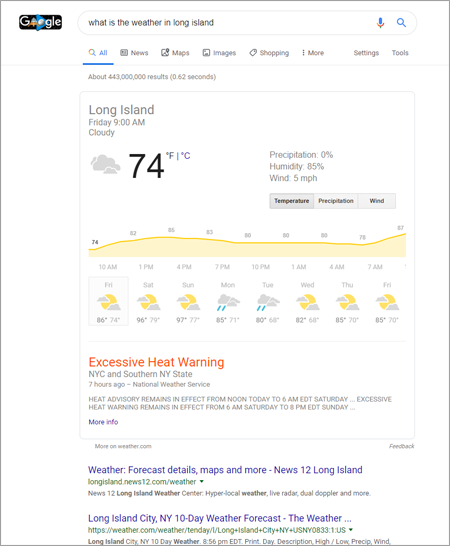
You’ve probably seen this new search trend on Google. When you search for a question, Google itself automatically provides you an answer to your search query in the form of a snippet from someone’s website. No clicking on or reading through websites required.

This search result is often referred to as Google Zero, or the zero-click result, and it’s the new aspiration for all websites out there.

How does it work? Imagine you type in a question in your search query, such as “What is the weather in Long Island?”  Before the Adwords results, and well before the organic search results, a box will pop up in which Google provides you with what they feel like is the best answer, lifted as a quote from some lucky website, in this case, weather.com.

Why does it matter? According to Jumpshot, 62% of search results now include a Google Zero answer. That means more and more keywords are becoming less profitable, as Google is taking them over themselves.

How to get your answer chosen, however, is the new holy grail.

While the automatic snippet does come from a website that ranks somewhere on the first page of the search engine results, there’s still no clear understanding of how companies ought to be optimizing their content to get chosen for the Google Zero spot.

And, it’s one of the biggest open opportunities out there in digital marketing’s future. The brand that figures out how to optimize their SEO for Google Zero will have a huge competitive edge over all the others in their industry.

Advertise Through Smart speakers

One of the most interesting developments of late is the smart speaker or the little AI speakers that have begun to run our homes.
According to Edison Research, 43 million Americans own a smart speaker. This is 18% of the adult population, in just 2+ years of existence.

These speakers are managed by AIs that go by the names of Alexa, Siri or Google Home, depending on the maker, and are offering a new potential advertising outlet to savvy marketers.

While branded advertising on smart speakers started in 2017, well before the speaker’s itself hit their heyday, ads were few and far between. Now, smart speakers’ ads are better, less invasive and more customer-friendly.

One of the best ways to advertise on smart speakers is to make what’s called a “branded skill.” For example, if you tell Alexa “Ask Patrón for a cocktail recipe,” Alexa will respond with a diverse selection of possibilities, courtesy of the premium tequila maker. According to Digiday Patrón gets more than 6,000 queries a month for its Alexa skill – it’s a strategy that works.

Give Your Content a Voice

Another opportunity that comes along with the AI world is to think of your content not just in written form, but in spoken word as well.


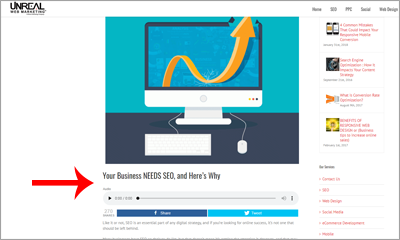
According to Google, 20 percent of all Google search queries now take place through voice search. That doesn’t apply to just Smart Speaker queries, either. According to Thrive Analytics, 71% of all mobile users between the ages of 18 and 29 use voice assistants on their smartphones.

For example, you can add voice to your blog with a platform like Amazon Polly, a text-to-speech service which synthesizes speech that sounds like a human voice. Check out our blog posts to hear this in action.

If the trend continues, which it probably will, optimizing your content for voice search is going to be a new business necessity. There’s a lot of tips on how to do this, but the consensus boils down to making content more conversational in tone. Optimizing your content for spoken queries now will put you ahead of the game as voice searches begin to take over, bringing you well ahead of the competition.

Your Business NEEDS SEO, and Here’s Why

Your Business NEEDS SEO, and Here’s Why

Like it or not, SEO is an essential part of any digital strategy, and if you’re looking for online success, it’s not one that should be left behind.

Many businesses have SEO on their to-do list, but that doesn’t mean it’s getting the attention it deserves, and that may be because many business owners don’t entirely understand WHY SEO is so important.

Read on to discover why SEO is essential to the success of your business, and what value it can offer you (beyond visibility).

Improved User Experience

SEO & User Experience

In its essence, SEO aims to create a strong, well-designed website with quality content and excellent user experience. SEO makes your website easy to find, easy to use, and ultimately provides your visitors with the service or information they’re looking for without a hassle.

These qualities don’t only improve your search ranking – they also make for a better user experience, which means your all-important clients will be happier with the service you provide. Satisfied clients, happy business owners.

Trust & Credibility

Anyone can build a website these days – so how do you stand out from the noise? High ranking websites have some similar qualities: they have positive user behavior, optimized on-page elements, and a quality backlink profile, which makes them credible, authoritative sources of information in their industries.

These same qualities that make a website SEO friendly also improve the credibility of the website, and thus of your brand. The authority that puts your website high in the search ranking is the same that leads customers looking for information to trust your company’s offerings.

Increased Conversions

Organice Search & Trust

Working on SEO is about creating a better website structure that makes it easier for bots to crawl, which also makes your website easier for your human customers to use. So, at the same time, you’re upping your SEO ante, you’ll be improving the conversion rate of your website, naturally.

SEO’s goal is to optimize your website for engagement and traffic flow – which also means that you’re more likely to get users to your end goal. Whether that end goal is an online purchase, an inquiry, hitting the contact page or simply clicking on a product, quality SEO – aka a well-designed, easy to use, highly informative site – will help get your users there.

Organic Search Still Rules

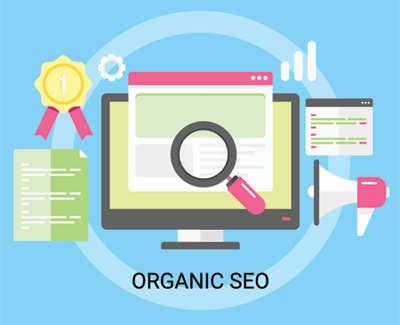
Organic search is still, in most cases, the primary source of website traffic for the majority of websites, and it’s a huge part of most website’s performance stats. Organic search is also an essential part of the purchase funnel – and about 75% of the search world these days is owned by Google.

Following Google’s SEO rules isn’t just a way to get more visibility in search, however. It also means you’ll also get better listings in Google Map searches, on Google’s My Business section, and in Gmail emails. Being highly visible in Google’s universe isn’t just great for searches – it adds credibility and that’s always going to work in your brand’s favor.

Increasing Real-Time Traffic

Local SEO works to improve your digital footprint inside of a specific, geographic region – be it a town, city, or even state – to make your brand more visible amongst local searchers. Thanks to the prevalence of mobile internet users, local search rankings are taking over the digital strategy of small and medium-sized businesses.

Regionally targeted searches aren’t just about driving web traffic, either. Local SEO can increase the number of physical visits to your brick-and-mortar location, too. High local search rankings will help new customers find your business quickly and easily, getting them one step closer to a purchase transaction.

It’s Low Cost, High Reward

Sure, optimizing your website does take some effort, so if you don’t feel you have enough bandwidth, consider hiring a reputable SEO company. Compared to purchasing keywords, SEO is relatively inexpensive, and the payoff can be huge. Great SEO isn’t a simple marketing cost – it’s an investment in the well-being of your business. So giving it the time, attention, and resources, it deserves, will only lead to bigger and better successes in your business’s future.

SEO Fundamentals, 101

SEO Fundamentals, 101

Getting SEO right starts with having a great foundation. If you don’t know the basics of SEO, no amount of optimization is going to get your website to the top. Read on to learn some of the ground rules to SEO that you’ll need to know to get your website off on a sound search footing.

Website Structure

The first thing that you need for high ranking search results is to build your website using a solid structure, including bot accessibility, dedicated hosting, mobile design, schema markup and sitemaps. You’ll want to make sure that your URL structure and your internal link architecture is search-friendly.

Don’t worry if none of this makes sense to you from the start. A good web developer will be able to implement all of these into your website, and it’s worth the investment to make sure your website’s foundation is solid from the very beginning.

Unique content

Another critical factor in building your website is being sure that you fill it with quality, unique content. Duplicate content – text or images you’ve copied from somewhere else on the web – won’t rank; and neither will unnecessary, superfluous, or poorly written content that’s just trying to get keyword hits. Search bots are more sophisticated than you might imagine, and if you’re looking to get high up in searches, you’ll need to provide your own unique and relevant content to do so.

If writing isn’t your forte, you can always hire a professional content writer to make sure your website content is original and up to par.

Title Right

The title tag on your homepage is one of the most important parts of your website. It should be the main focus of your business, and hopefully, the main traffic driver as well.

A few tips for choosing a title: if your business is local, include the city or town’s name in the title tag to ensure you’ll rank in locally-based searches. You don’t want to be competing in nationwide searches when your most important clients are searching locally!

Backlinking

Backlinks are links from other websites that point back to your site, and they are one of the keys to Google’s search algorithm. However, with backlinks, quality beats quantity every time.
Acquiring backlinks can be tricky – you need to get highly authoritative websites in your market – be it in your region or in your industry – to link to your website, naturally, for these links to help your search ranking. Considering signing up for services like HARO (Help a Reporter Out), where you can respond to questions from media outlets on behalf of your company. It might just get you some links in the digital media, which could rocket your website’s search ranking.

You can also use digital PR tactics to increase your links. Reaching out to industry related websites, groups, or partners to add links to their websites back to you are all great tactics to improve your backlink search rating.

Local Listings

If you haven’t been paying attention to your Google My Business page, it’s time to start, as it’s one of the main ways that Google ranks local businesses in map searches.

Go to My Business and make sure that all of your information is correct, and your photos are up to date. Be proactive with asking customers for reviews, and then measure your views via the insights section to see what sort of response your business is having in local searches. As with any metrics, the key is to monitor, and modify when needed to improve your online ranking.

Keep it up!

It is vital for successful SEO to keep your site up to date, legitimate and mobile-friendly. Create ongoing, stellar content on a blog that is easily viewed on a desktop, tablet or phone, and actively promote your content via Facebook or other social media.

All of these will help to improve your search ranking and drive more traffic to your website, ultimately adding to your overall business success.

Maintaining your website content and performing a successful SEO strategy is ongoing. To stay ahead of the game, enlist the services of a qualified SEO company to keep your rankings on page 1.

Conversion Rate Optimization Explained

Conversion Rate Optimization Explained

Conversion Rate Optimization - CRO

Whats is Conversion Rate Optimization?

What Is Conversion Rate Optimization?

Any user who visits your website or app and completes the “end goal” – purchases something from your online store, fills in your contact form, or the like – is a conversion. While there are countless ways to get more users to visit your site, none of them matter if your users aren’t converting.

Conversion rate optimization (CRO) works to increase the number of users that convert, getting you more value from the visitors you already have. By increasing the revenue per visitor, you’re decreasing your cost per acquisition, which will ultimately allow you to attract more customers and grow your business.

How Does Conversion Rate Optimization Work?

Imagine that your landing page received 5,000 visitors per month, and 500 of them convert. That would make your conversion rate 10%. CRO works to optimize different elements on your page (and throughout your website) to increase the number of people that convert, to drive that percentage up.

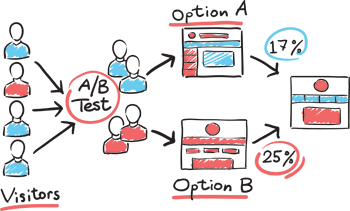
CRO generally works using experimental processes – trial and error.  A CRO professional will work with you to come up with ideas to improve certain elements on your site and then will put those ideas to the test using A/B and multivariate testing.

The best companies are constantly testing and improving their apps and sites to create an optimal experience for their users and improve conversion rates. There is practically an infinite number of improvements that you could make on any website, so you’ll need to establish your conversion metrics and set specific goals before determining the best CRO strategy for your business at any given time.

Establishing Metrics

Conversion rate optimization starts with knowing what your conversion goals are. These success metrics depend heavily on what type of business you run. For instance, if you run an online shop, then a conversion for you probably means a user makes a purchase, however, you might also measure conversions based on how many users add a specific item to their shopping cart, or how many enter in contact with your company.

Service-based businesses might measure conversions based on the number of leads your site produces, or on the number of informative downloads, while a media company might count newsletter subscriptions or pageviews as conversions.

How to Optimize

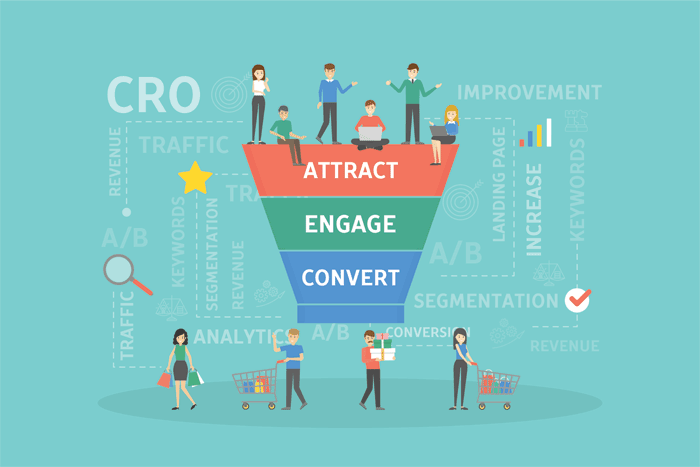
Once you know what your conversion metrics are, the next step is to identify areas in which you can improve your “conversion funnel” – or the process through which you get conversions via your site or app – to increase the total number of conversions achieved.

Begin by focusing on the part of your website that receives the most amount of traffic, or that historically has generated the largest number of conversions. These are the pages where you’ll generally see better results quicker, making them higher value areas to focus on.

Alternatively, if your site is already high performing, you might want to focus your CRO efforts on any areas of your website that are underperforming in comparison – such as a page that receives a relatively high amount of traffic, but a relatively low number of conversions. Here you’ll find the greatest room for improvement.

How to start Conversion Rate Optimization

Have you ever been on a newspaper’s website and see the same article posted twice (probably in two different sections) under two different headlines? That’s an example of A/B testing. The website is giving the user two different ways to get to the same content, to see which headline garners more clicks.

CRO works the same way. After determining which pages to optimize, you need to come up with optimization ideas and begin A/B testing. For example, if you think one photo, or one headline, will drive more clicks over another, then put your idea to the test.

If you’re at a loss, consider working with a CRO professional to get your website up to par, and improve the number of conversions – and thus the success of your business – quickly and easily.

Reach Marketing announced that it has acquired UnReal Web Marketing

Reach Marketing announced that it has acquired UnReal Web Marketing

Pearl River, NY, April 3, 2019– Today, Reach Marketing announced that it has acquired UnReal Web Marketing’s award-winning search, social media, web design, and digital analytics business. UnReal Web Marketing will remain a separate company and help power the strategy and software behind Reach Marketing’s SEO, PPC, social media, User Experience (UX) and marketing automation programs.

Greg Grdodian, CEO at Reach Marketing said, “We’re very pleased to add UnReal Web Marketing to our corporate family. They’ve quickly become a respected provider, earning a stellar reputation as a leading specialist in local and national search solutions, including Search Engine Optimization, Pay Per Click, Social Media, Web Design and E-Commerce marketing.”

“Marketers’ singular pressing need today is for profitable growth using optimal technologies. We’re excited to offer clients our combined resources and value-added technologies backed by the strong management team we’ve built together,” says Wayne Roberts, Reach Marketing’s President.

Roberts added “Working with UnReal as it becomes part of Reach Marketing’s performance marketing agency will expand our mission critical services and help us deliver key search expertise and technologies to our customers worldwide.”

David Montalvo, UnReal Web Marketing’s original founder will continue as the company’s VP, Web Marketing Services to lead its next stage of growth. He stated, “I’m very impressed with Reach Marketing’s deep technology and management bench, and the deliberate steps it has taken to become a leader in enterprise-scale technology solutions. Our position in the marketplace coupled with massive growth within search and social provides a quick path to expand the business. I’m looking forward to working with their talented team to provide innovative search solutions to its customers and help them achieve greater success.”

The new company will be known as UnReal Web Marketing, a Reach Marketing Company.

For more information about Reach Marketing and the company’s full range of data enrichment, lead generation, email marketing, database architecture, SEO/PPC, web design and sales and marketing automation solutions, contact Greg Grdodian Greg.Grdodian@reachmarketing.com or call 1.855.TO-REACH.

#     #     #

About Reach Marketing

Based in New York, Los Angeles and Miami, Reach Marketing ranks among the largest independent providers of customer data platforms, full-service email marketing, and search automation solutions helping to drive web and mobile traffic and engagement for leading brands worldwide.

Reach Marketing is a customer-driven, omni-channel marketing firm fueled by best-in-class technology supported by its proprietary MARKETING AI®. Reach Customer Data Platform solutions enable marketers to acquire and retain customers using effective digital marketing channels, improving user experience through web design and full-service email marketing, data enrichment assets, CRM, marketing automation and ROI analytics. Reach customers include leading brands in the E-Commerce, Health Care, Financial Services, Wholesale, High Tech, Training, and Media industries.

Reach Marketing and MARKETING AI are registered trademarks of Reach Marketing, LLC.