
SEO budgeting in 2026 is no longer a simple decision between content production, technical SEO, and link building. Search has become a multi-surface ecosystem where visibility is earned across traditional results, AI-generated answers, and entity-driven recommendation systems. CMOs and marketing leaders must build SEO budgets that protect foundational performance while also funding emerging channels like AI Overviews, answer engines, and large language model discovery.
In Q1 and the first half of 2026 (H1), the brands that outperform will not be the ones that publish the most content. They will be the ones that invest in the right SEO infrastructure, create structured and quotable content, and strengthen the authority signals that both search engines and AI systems rely on.
The 2026 SEO Budget Reality CMOs Need to Understand
The biggest shift in 2026 is that SEO is no longer limited to “Google rankings.” Today, users search in more places and consume information in new ways. AI-generated answers are increasingly replacing informational clicks, and discovery is being influenced by systems that summarize, interpret, and cite content rather than simply ranking it.
This means SEO budgets must support visibility in environments where the user may never visit your website directly. If your content is not structured, trustworthy, and easy for machines to interpret, your brand will lose visibility even if you technically rank. In 2026, SEO budgeting is a visibility strategy across multiple discovery layers.
A Modern SEO Budget Framework for 2026
A strong SEO budget in 2026 should be organized into three strategic layers. This approach prevents SEO from becoming reactive and ensures that both short-term stability and long-term growth are funded consistently. Most organizations underperform because they treat SEO like a single line item, when it should be structured like a portfolio.
The three layers are: foundational protection, growth investment, and AI visibility innovation. Each layer serves a different purpose and produces different outcomes. When CMOs fund all three, the brand gains resilience, scalability, and a competitive advantage in emerging search experiences.
SEO Budget Layers
| Budget Layer | Primary Goal | What It Funds | Why It Matters in 2026 |
|---|---|---|---|
| Foundation | Protect rankings + stability | Technical SEO, site structure, maintenance | Prevents crawl/index issues and supports AI interpretation |
| Growth | Drive leads + revenue | High-intent pages, conversion SEO, content clusters | Captures decision-stage searches that still convert |
| AI Visibility | Expand discovery surfaces | GEO, AEO, LLMO, structured data, citation optimization | Increases inclusion in AI answers and summaries |
Layer 1: Protect the Foundation With Technical SEO
Technical SEO remains the most critical “non-negotiable” in Q1. It is the part of the budget that ensures your website can be crawled, indexed, and understood correctly. In 2026, technical SEO is not only about Googlebot. It also supports content extraction for AI systems, entity interpretation, and citation-based inclusion.
Key technical priorities include improving crawl efficiency, resolving duplicate content issues, fixing indexation inconsistencies, strengthening internal linking, and ensuring mobile and performance standards are met. If your site has structural problems, AI engines are more likely to misunderstand your content, ignore key pages, or misrepresent your brand in summaries. Technical SEO is the foundation that every other visibility strategy depends on.
Technical SEO Priorities for Q1 2026
To keep this easy for planning, here are the top priorities CMOs should fund early:
- Crawlability and indexation cleanup
- Internal linking improvements (hub-and-spoke clusters)
- Canonicalization and duplicate content resolution
- Core Web Vitals improvements (where it impacts engagement)
- Structured data validation and expansion
- Mobile UX and page experience improvements
- Redirect audits and broken link fixes
- Sitemap and robots.txt alignment
Layer 2: Build Revenue-Focused SEO Assets
The second layer of SEO budgeting should focus on assets that drive measurable growth. This is where content and SEO strategy intersect with pipeline, leads, and revenue. In 2026, informational traffic alone is less reliable because AI answers increasingly reduce clicks. For this reason, the most important SEO assets are high-intent pages that match decision-stage searches.
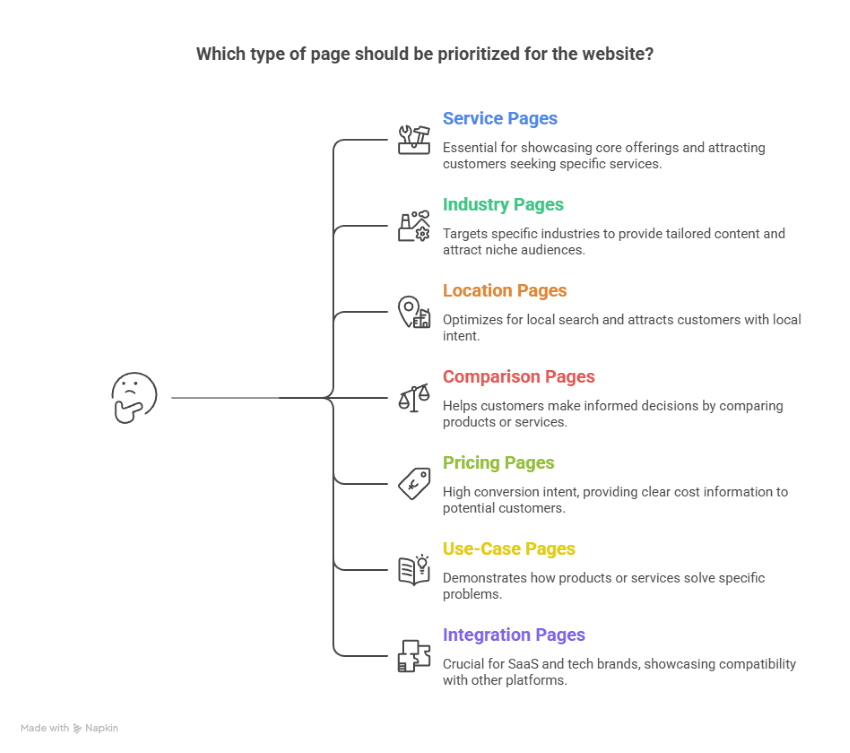
These include service pages, product pages, industry-specific landing pages, location pages (if relevant), comparison pages, and solution-based content. The goal is not to publish broadly, but to publish with intent. CMOs should prioritize SEO assets that are tied to conversion outcomes, not vanity metrics. In 2026, high-intent SEO is one of the strongest long-term ROI channels when executed correctly.
High-Intent SEO Page Types to Scale in 2026
These page types tend to produce the strongest ROI:
- Service pages (core offers)
- Industry pages (vertical targeting)
- Location pages (local intent + city modifiers)
- Comparison pages (“X vs Y,” “best,” “top”)
- Pricing and cost pages (high conversion intent)
- Use-case pages (problem/solution alignment)
- Integration pages (for SaaS and tech brands)
Layer 3: Fund AI SEO, GEO, AEO, and LLMO
The third layer is where most brands are currently under-investing. AI-driven discovery is not a future trend. It is already reshaping how users find information and how brands earn trust. CMOs should allocate a dedicated budget to AI visibility initiatives so these efforts do not compete with traditional SEO maintenance.
This layer includes GEO (Generative Engine Optimization), AEO (Answer Engine Optimization), and LLMO (Large Language Model Optimization). These strategies focus on increasing the likelihood that your brand appears inside AI answers, AI summaries, and citation-driven recommendation systems. The brands that invest in this layer early will build durable visibility advantages while competitors remain stuck in traditional ranking-only thinking.
AI SEO Terminology (Simple Definitions)
| Term | What It Means | What It Targets |
|---|---|---|
| AEO | Answer Engine Optimization | Featured snippets, People Also Ask, AI answer blocks |
| GEO | Generative Engine Optimization | Google AI Overviews, Bing Copilot, Perplexity |
| LLMO | Large Language Model Optimization | ChatGPT, Gemini, Claude, AI recommendations |
Q1 2026 Priority: Fix the SEO Infrastructure First
Q1 should be treated as the stabilization quarter. The objective is to reduce technical debt, strengthen site structure, and prepare content systems for scalable growth. Many companies rush into AI SEO experiments while their site architecture is broken, their content is unstructured, and their internal linking is weak. That approach produces unreliable results.
In Q1, CMOs should prioritize foundational improvements because they create compounding returns. A site that is clean, fast, properly structured, and internally linked will not only rank better. It will also be easier for AI systems to interpret and cite. Q1 is the quarter where you make your website a machine-readable asset, not just a marketing brochure.
Q1 2026 Priority: Structured Content That Wins in Search and AI Answers
Structured content is no longer just a readability advantage. In 2026, it is a visibility requirement. AI systems and search engines increasingly rely on structured signals to extract meaning from content. This includes headings, lists, tables, summary blocks, FAQs, and schema.
In Q1, CMOs should ensure content teams are producing pages that are easy to scan, easy to quote, and easy to interpret. The most effective format is often “answer-first” content, where the primary question is answered immediately, followed by supporting detail. This improves performance in featured snippets, People Also Ask, and AI Overviews. Structured content also increases conversion performance because it reduces friction for users who are scanning for clarity.
Structured Content Checklist (AEO-Friendly)
To improve performance in AI and search answer surfaces, ensure pages include:
- A direct answer in the first 2–3 sentences
- Clear H2 sections aligned to user questions
- Short paragraphs (2–4 lines)
- Bullet lists for processes, benefits, and steps
- Tables for comparisons and cost breakdowns
- FAQ section with concise answers
- Schema markup (FAQ, Article, Organization, Product where applicable)
Q1 2026 Priority: Refresh Existing Content Before Publishing More
One of the most cost-effective SEO strategies in 2026 is content refreshing. Many brands have hundreds of pages ranking in positions 4–15, or pages that once performed well but are now losing clicks due to AI summaries. Updating these pages is often far cheaper than producing new content and can deliver faster results.
Content refresh work should include updating statistics, improving clarity, adding internal links, improving structure, adding FAQs, and strengthening topical depth. In Q1, CMOs should fund a formal content refresh program rather than allocating the entire content budget to net-new publishing. The fastest wins often come from upgrading what already exists.
Content Refresh Priorities (Best ROI)
Focus refresh efforts on:
- Pages ranking positions 4–15
- Pages with declining clicks but stable impressions
- Pages with outdated 2024–2025 data
- Pages with weak intros and poor structure
- Pages with no FAQ section or schema
- Pages that are thin compared to top competitors
What AI SEO Means in 2026
AI SEO is not the same as using AI tools to write content faster. That approach often produces generic output and increases the risk of publishing low-value pages. In 2026, AI SEO refers to optimizing content so that AI systems can understand it, trust it, and reference it. This requires strong structure, strong topical alignment, and clear brand credibility.
AI SEO also includes ensuring that your site has strong entity signals. Search engines and AI models interpret brands as entities, not just websites. If your organization lacks clear identity signals, inconsistent naming, weak author credibility, or poor structured data, you are less likely to be surfaced in AI answers. AI SEO is about becoming the most interpretable and most credible source for a topic, not just the most keyword-optimized.
What Is AEO and Why It Matters in 2026
AEO stands for Answer Engine Optimization. It focuses on making your content eligible for direct-answer surfaces like featured snippets, People Also Ask, and AI-driven answer modules. In 2026, these surfaces are more influential than ever because they often reduce clicks and compress the user journey.
AEO is built on clarity and precision. Content should answer questions directly, avoid fluff, and include short definitions that can be extracted cleanly. FAQ sections, summary blocks, and structured formatting improve AEO performance. CMOs should treat AEO as a core part of the content strategy because it increases visibility even when users do not click. In many industries, AEO has become a primary brand awareness channel.
What Is GEO and Why It Matters in 2026
GEO stands for Generative Engine Optimization. It focuses on being included in AI-generated summaries and responses, including Google AI Overviews, Bing Copilot, and Perplexity. Unlike traditional SEO, GEO is not only about ranking. It is about being selected as a source and being referenced as a trusted authority.
GEO depends heavily on structured content, strong entity signals, and external authority. AI systems tend to cite sources that are consistent, credible, and widely referenced across the web. CMOs should fund GEO work because it directly impacts brand visibility in the most disruptive discovery surfaces of 2026. GEO is quickly becoming a competitive moat, especially in industries where informational queries dominate.
What Is LLMO and Why It Matters in 2026
LLMO stands for Large Language Model Optimization. It focuses on how brands appear inside conversational AI systems like ChatGPT, Gemini, Claude, and Copilot. These platforms are increasingly used for product research, service recommendations, and decision-making. If your brand is not visible in these systems, you are losing market share in a channel that is growing rapidly.
LLMO requires more than content. It requires consistent brand messaging, strong authority signals, structured data, and clean website architecture. It also requires external citations and references that reinforce your credibility. CMOs should fund LLMO because conversational AI is becoming a standard discovery path, especially for B2B, high-consideration purchases, and service-based industries.
H1 2026 Priority: Scale High-Intent Pages and Conversion SEO
Once Q1 stabilization is complete, the first half of 2026 (H1) becomes the growth phase. This is when CMOs should scale the production of high-intent pages that capture decision-stage searches. The goal is to ensure the brand dominates the queries that lead to revenue, not just the queries that generate impressions.
H1 content should prioritize service pages, industry pages, location expansions (if relevant), and comparison pages. Conversion optimization should be integrated into SEO, including stronger CTAs, clearer page structure, improved UX, and trust-building elements. In 2026, SEO and conversion performance must work together. Ranking without conversion is wasted budget.
H1 2026 Priority: Authority Building Through Links and Mentions
Authority still matters in 2026, but it is broader than backlinks alone. AI engines and search engines rely on signals that indicate trust. These include editorial mentions, citations, partnerships, and references from credible sources. CMOs should fund authority-building campaigns that support both traditional SEO and AI visibility.
A modern authority strategy should combine digital PR, niche placements, industry partnerships, and content assets designed to earn citations naturally. This also strengthens GEO and LLMO performance because AI systems tend to prefer sources that are widely referenced. Authority is not optional in 2026. It is a requirement for competitive visibility.
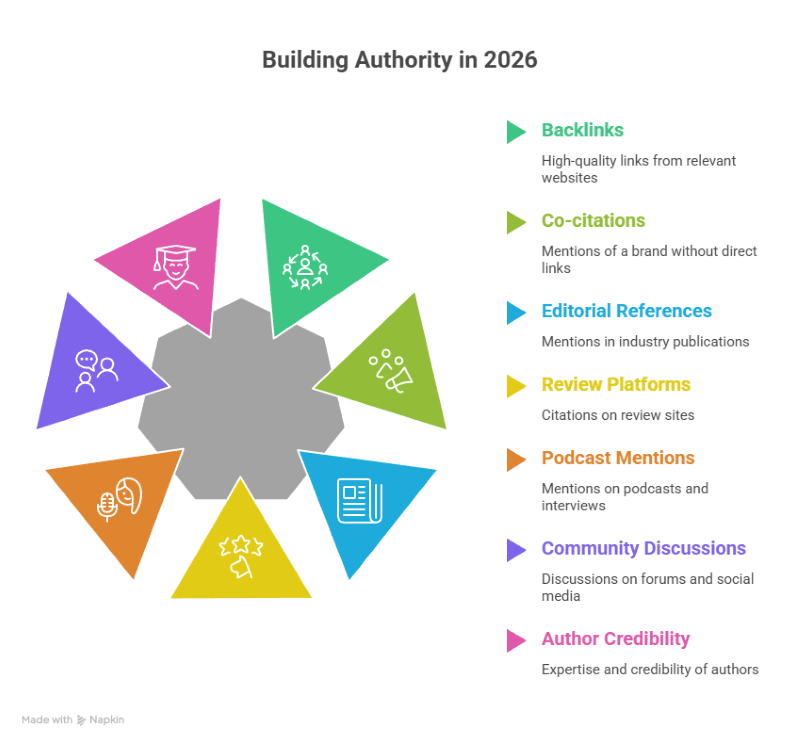
Authority Signals That Matter in 2026
Authority is built through:
- High-quality backlinks from relevant sites
- Brand mentions without links (co-citations)
- Editorial references in industry publications
- Review platforms and directory citations (local SEO)
- Podcast mentions and interview placements
- Community discussions (Reddit, forums, niche groups)
- Author credibility and clear expertise signals
H1 2026 Priority: Scale AI Visibility Assets
The first half of 2026 (H1) is also the right time to scale AI-focused assets that were tested in Q1. These assets should be repeatable and measurable. The goal is not to “do AI SEO” as a side project. The goal is to build an AI visibility layer into the SEO program.
Examples include structured glossary systems, topic hubs, entity-based landing pages, embedded summary blocks, expanded schema coverage, and FAQ-driven content frameworks. CMOs should treat these as strategic assets that increase the probability of being cited, summarized, and referenced across AI platforms. In 2026, the brands that build AI visibility systems will outperform brands that only chase rankings.
Suggested SEO Budget Allocation for 2026
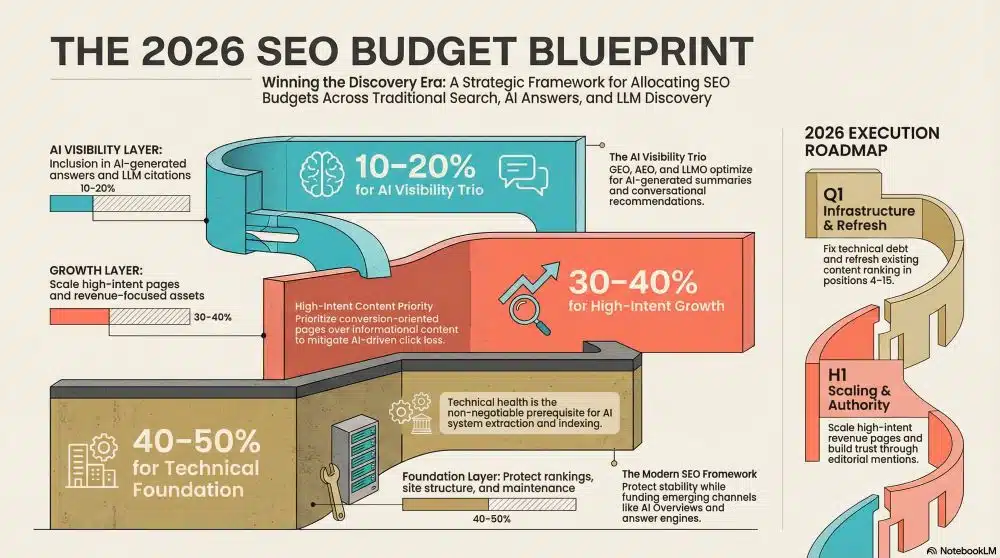
Most organizations need a balanced allocation that protects the foundation, funds growth, and supports innovation. While every industry differs, a strong baseline model is to allocate roughly half the budget to technical and maintenance work, a large portion to revenue-focused growth assets, and a dedicated portion to AI SEO initiatives.
A practical model for many brands is 40–50% foundation, 30–40% growth assets, and 10–20% AI visibility initiatives. Competitive industries may require a larger AI allocation. The key is to ensure AI work is funded consistently and not treated as optional. Without dedicated funding, AI visibility becomes inconsistent and fails to produce long-term gains.
Sample Budget Split (Example)
| Category | Suggested Range |
|---|---|
| Technical SEO + Maintenance | 40%–50% |
| High-Intent Content + Conversion SEO | 30%–40% |
| Authority Building | 10%–15% |
| AI SEO (GEO/AEO/LLMO) | 10%–20% |
The SEO Tool Stack Audit: A Hidden Budget Win
Many brands waste SEO budget on tools that overlap or do not provide actionable insights. In the first half of 2026 (H1), CMOs should audit the SEO tech stack to reduce waste and improve clarity. The goal is not to remove all tools. The goal is to eliminate redundancy and reinvest in strategy, execution, and content quality.
Tools should be evaluated based on whether they improve decisions and outcomes. If a tool only produces reports but does not improve performance, it may not justify its cost. CMOs should prioritize tools that support technical audits, performance measurement, AI visibility tracking, and content optimization. In 2026, fewer tools with clearer impact often outperform bloated tool stacks.
What CMOs Should Ask Before Approving SEO Spend in 2026
SEO budgets are often approved based on legacy assumptions. In 2026, CMOs should challenge those assumptions with sharper questions. The goal is to ensure the SEO program is aligned with how discovery actually works today. A budget that funds publishing but ignores structure, authority, and AI visibility will underperform.
CMOs should ask whether the program funds maintenance and growth, whether AI visibility is built into the strategy, whether structured content and schema are prioritized, and whether measurement reflects modern discovery. SEO is now a multi-channel visibility system. If budgets are still designed around a 2018 search model, the brand will fall behind.
CMO SEO Budget Questions (Quick Checklist)
- Are we funding technical SEO and maintenance consistently?
- Are we prioritizing high-intent pages tied to revenue?
- Do we have a formal content refresh program?
- Are we investing in structured content and schema?
- Do we have a dedicated AI visibility budget (GEO/AEO/LLMO)?
- Are we investing in authority signals beyond our website?
- Are we measuring AI visibility and citations, not just rankings?
Final Takeaway: SEO Budgets Must Match the New Discovery Landscape
SEO in 2026 is not a single-channel tactic. It is a discovery strategy across traditional search, AI answers, and conversational recommendation systems. CMOs who fund SEO like a modern visibility engine will protect performance today while building the foundation for future growth.
The strongest SEO budgets in 2026 are balanced. They protect technical health, scale high-intent growth assets, build authority, and fund AI-driven visibility initiatives. The brands that treat SEO this way will not only rank. They will be cited, referenced, and recommended across the platforms shaping discovery in 2026.
FAQ: SEO Budget Priorities in 2026
1) What is the biggest SEO budget mistake CMOs make in 2026?
The biggest mistake is overspending on net-new content while underfunding technical foundations, content refresh work, and AI visibility initiatives like GEO, AEO, and LLMO.
2) Should SEO budgets increase in 2026?
In most industries, yes. Discovery is expanding into AI systems and answer engines, which requires additional investment in structured content, authority signals, and measurement.
3) How much of an SEO budget should go to technical SEO?
A common benchmark is 40–50%, especially in Q1. Technical SEO supports rankings, crawlability, and AI-driven content interpretation.
4) What is AEO in SEO?
AEO stands for Answer Engine Optimization. It focuses on structuring content to win featured snippets, People Also Ask, and AI answer modules.
5) What is GEO in SEO?
GEO stands for Generative Engine Optimization. It focuses on visibility in AI-generated summaries like Google AI Overviews, Bing Copilot, and Perplexity.
6) What is LLMO in SEO?
LLMO stands for Large Language Model Optimization. It focuses on how brands appear and are referenced inside conversational AI systems like ChatGPT, Gemini, and Claude.
7) Is link building still important in 2026?
Yes. Authority signals remain critical, and links, citations, and mentions influence both traditional SEO rankings and AI inclusion.
8) Why does structured content matter more in 2026?
Structured content improves machine readability. AI systems rely on headings, lists, FAQs, and schema to extract and summarize meaning accurately.
9) Should CMOs invest in AI SEO tools?
Only if the tools produce actionable insights. Many AI SEO tools are expensive and redundant. A tool stack audit is recommended in H1.
10) What should be prioritized first in Q1 2026?
Q1 should prioritize technical SEO cleanup, structured content upgrades, and content refresh initiatives before scaling new production.
11) What should be prioritized in the first half of 2026 (H1)?
H1 should scale high-intent landing pages, authority building, and AI visibility assets proven in Q1 testing.
12) How do you measure SEO success in 2026?
SEO success should be measured using a combination of rankings, organic traffic, conversions, assisted conversions, and AI visibility indicators such as citations and inclusion in AI answers.
Author
David Montalvo is a senior SEO strategist and Founder of UnReal Web Marketing, with over 25 years of experience in SEO, PPC, and full-funnel digital marketing. Over the past two decades, his SEO initiatives have generated more than $650 million in incremental organic revenue, helping brands turn search visibility into measurable business growth. He has also worked with multiple Fortune 500 companies across a wide range of industries.
David’s client portfolio includes Mayo Clinic, Merrill Lynch (UK Division), Cardinal Health, JetBlue, Goodyear, Apple Bank, Jet Direct Mortgage, MLS, Morrell Instruments, Molloy Bros Moving, JD Funding, National Business Capital, Steinway Pianos, Yamaha, Hearst Publishing, Benzinga, ISOPURE, Construction Executive Magazine, Loomis Sayles, Mindray North America, BOMImed, SightMD, IRIS Software, Datascan Software, Globecomm, Hestan, One Way Furniture, RSS Staffing, Daniel Gale, Scott Cooper, Wholesale Chef Store, Admiral Craft, WindowRama, Ocean Air, Heller Tax Grievance, Propane Depot, Redefine Fitness, Grainger, LabSafety, Autoscope, the U.S. General Services Administration (GSA), and the State of Connecticut.
In addition to his client and enterprise work, David is a sought-after keynote speaker, regularly sharing advanced insights on SEO strategy, AI-driven search, and digital performance marketing with audiences nationwide.