
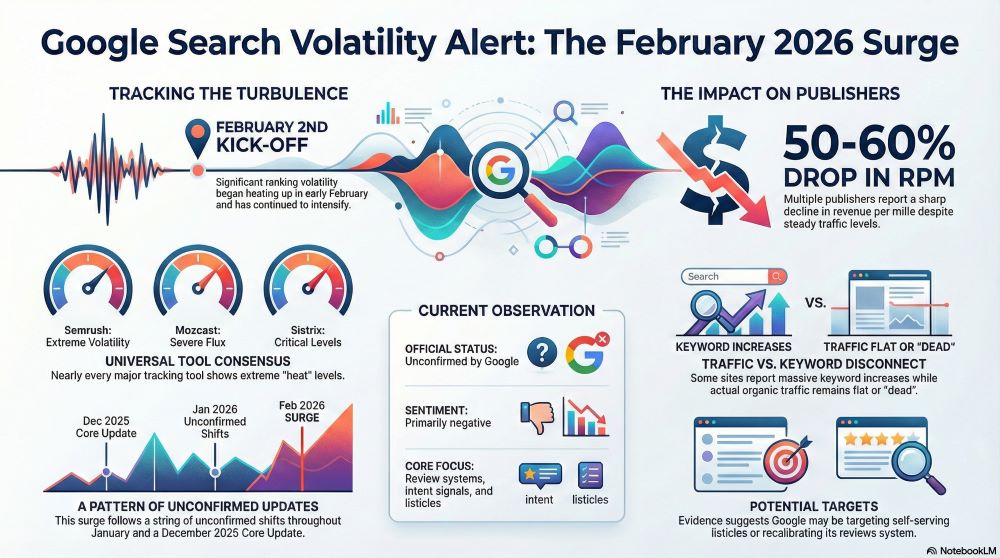
Google Search is showing unusually high ranking volatility again, and this time it feels more intense than a typical “weekend shuffle.” Based on the latest reporting and the broader pattern of volatility through late January and early February, we’re likely looking at a mix of unconfirmed algorithm adjustments plus continued rollout and recalibration tied to AI-driven search features.
Even without an official announcement from Google, the SEO community is seeing consistent signs: sharp ranking swings, unstable visibility, unpredictable traffic drops, and major fluctuations across verticals.
This article breaks down what’s happening, what real site owners are experiencing, what patterns are emerging, and what SEO teams should do next.
What’s Happening Right Now in Google Rankings
Rankings Are “Heated” Again (Feb 2–4, 2026)
Multiple SEO tracking tools and community chatter indicate a strong spike in ranking changes around February 2, 2026, with volatility continuing into the following days.
This isn’t just minor turbulence. It resembles the type of movement typically associated with:
- Broad algorithm tuning
- Quality system recalibration
- Search layout changes
- AI Overview expansion
- SERP experimentation
Google has not confirmed a core update during this time, but this kind of volatility does not usually happen without meaningful ranking system adjustments.
Why This Volatility Matters More Than Normal
Ranking volatility is common in Google. The difference right now is:
- It’s sustained (not just 24–48 hours)
- It’s multi-platform (Search + News + Discover + Images)
- It’s impacting publishers and e-commerce sites simultaneously
- It aligns with ongoing AI changes in the SERPs
When volatility hits multiple Google surfaces at once, it often indicates the ranking systems are being adjusted in a way that affects how Google decides what deserves exposure, not just how pages reorder in blue links.
What Site Owners Are Reporting
To make this report more educational, it’s worth including what real site owners are seeing. These are not “light” complaints — some are describing catastrophic loss events.
A Publisher Reporting a 95% Collapse Since December
One publisher described a long-term collapse that began around December 12, with traffic falling from 50,000 clicks per day down to around 40 clicks per day.
What makes this especially alarming is the scope of the loss:
- Search visibility collapsed
- Google Images traffic disappeared
- Google News visibility disappeared
- Google Discover visibility disappeared
- Rankings appear “unchanged” for tracked terms, yet impressions are gone
This is a critical detail. It suggests that what’s happening may not simply be “ranking down,” but potentially:
- a site-wide suppression
- a visibility dampening system
- a platform distribution issue (News/Discover eligibility loss)
- or a deeper quality classifier hit
In plain English: some publishers are reporting they were essentially removed from discovery systems, not just moved down a few positions.
Google News Indexing Can Become a Hidden Bottleneck
Another key observation from the discussion: some sites still get indexed quickly, but their articles appear on the last pages of Google News results.
That matters because:
- Discover visibility often correlates with strong News indexing
- News placement affects how quickly a site regains momentum
- Being indexed “fast” does not mean being “distributed”
This is one of the most overlooked truths in 2026 SEO: indexing is not the same as visibility.
Some SEOs Say the SERPs Are Getting “Worse”
Other comments reflect a different frustration: the perception that Google is rewarding low-quality, AI-generated, or even fraudulent sites, while burying legitimate publishers.
Several themes show up repeatedly:
- “We follow all the rules and still lose visibility.”
- “Fraudulent or imposter sites are ranking on page one.”
- “Competitors with junk backlink profiles are outranking real content.”
- “AI content is winning because it matches Google’s preferred formatting.”
Whether or not every claim is objectively true, the sentiment is important: trust in ranking fairness is eroding, and that impacts how publishers invest in content.
The Most Likely Explanation: This Volatility Is AI-Driven
A large portion of the discussion suggests the volatility is strongly correlated with Google expanding and testing AI Overviews (AIO) and possibly preparing for broader adoption of AI Mode.
While we can’t prove a direct causal link without Google confirmation, the logic is reasonable:
- AIO placement changes click distribution
- AIO can reduce organic CTR even when rankings stay stable
- AIO can suppress entire categories of informational traffic
- Google may be recalibrating what content gets cited in AIO
This lines up with broader reporting that AI Overviews can significantly impact click behavior when present.
What This Means for SEO in 2026
Rankings Alone Are No Longer the Whole Game
In 2026, you can rank #1 and still lose traffic if:
- AI Overviews answer the query before the click
- the SERP is filled with widgets, videos, and shopping modules
- your result is pushed below the fold
- Google chooses not to cite you in AI-generated answers
This is why AEO (Answer Engine Optimization) is no longer optional.
AEO Insight: Google Is Training Users Away From Blue Links
One of the smartest points raised in the comments is this:
Google is conditioning users to treat AI answers as the “main result,” and blue links as secondary.
That aligns with how SERPs now behave:
- AI Overviews appear above traditional results
- Organic results often become “supporting sources”
- Search becomes a summary engine rather than a discovery engine
For publishers, this changes the business model dramatically.
The New SEO Reality: Google Can Reduce Your Traffic Without Moving Your Rankings
This is the part that breaks a lot of traditional SEO thinking.
A publisher can report:
- “My rankings are the same.”
- “My traffic is gone.”
- “My impressions collapsed.”
That can happen when:
- AI Overviews take clicks
- Google reduces Discover distribution
- Google News positioning changes
- SERP layout pushes organic down
- Google reinterprets query intent
So if you’re auditing a site during volatility, you must look at:
- impressions and CTR
- SERP feature presence
- AIO visibility
- Discover and News performance
- query-level intent shifts
What Google May Be Targeting Right Now
Based on the broader reporting around this volatility period, there are a few plausible targets.
Self-Promotional Listicles and Low-Value “Best Of” Pages
There has been reporting suggesting Google may be pushing down self-promotional listicles and low-value roundup pages during recent unconfirmed updates.
That doesn’t mean “listicles are dead,” but it does mean:
- listicles without unique insight are at risk
- affiliate-heavy roundups may get suppressed
- generic “top 10” content is more volatile
Thin Content That Exists Only to Rank
Pages that exist purely for keyword capture (without depth, original analysis, or unique expertise) are increasingly unstable.
This is especially true now that AI systems can generate “average” explanations instantly.
Sites That Lost Trust in News/Discover Systems
For publishers, being pushed to the bottom of Google News can effectively remove them from Discover, and Discover loss can permanently reduce traffic even if Search remains stable.
What To Do Right Now (Practical SEO + AEO Checklist)
Step 1: Do Not Panic-Edit Your Site
During volatility, the worst move is rewriting everything at once.
Instead:
- document what changed
- compare winners vs losers
- wait 7–14 days before major structural changes
Step 2: Identify Which Pages Lost Clicks vs Which Lost Rankings
This matters because:
- ranking loss = relevance/authority issue
- click loss with stable ranking = AIO/CTR/intent issue
Step 3: Add AEO Blocks to Priority Pages
If you want AI engines to cite your content, build content that’s easy to extract.
AEO blocks should include:
- short direct answers (40–60 words)
- bullet lists
- tables
- FAQ schema
- clear headings
- definitions and comparisons
Step 4: Strengthen Brand Signals
This is not fluffy advice. In AI search, Google needs strong confidence signals.
Focus on:
- author transparency
- About page credibility
- citations and references
- consistent topical coverage
- real-world proof (photos, case studies, data)
Step 5: Diversify Traffic Sources
If your business depends on SEO traffic alone, you are exposed.
Publishers and service businesses should push:
- email lists
- YouTube and short-form video
- local SEO + GBP
- referral partnerships
- social distribution
- paid search for high-value queries
Key Takeaway: This Isn’t Just Volatility — It’s a Search Model Shift
This current “heated” volatility isn’t only about rankings. It’s about Google changing:
- how it displays information
- what it considers a “result”
- how much traffic it sends out
- how AI-generated answers replace clicks
That’s why so many publishers feel like the ground is moving under them. In many ways, it is.
FAQ: Google Ranking Volatility + AI Overviews (2026)
What is Google ranking volatility?
Google ranking volatility refers to significant changes in search result positions across many keywords and industries over a short period of time. High volatility usually indicates algorithm adjustments or major SERP changes.
Is Google running a core update right now?
Google has not officially confirmed a core update during this specific volatility period. However, the scale and duration of movement resemble patterns seen during major algorithm changes.
Why do rankings stay the same but traffic drops?
This can happen when Google changes the search layout or adds AI Overviews that answer the query without requiring a click. It can also happen if CTR drops due to SERP features.
Are AI Overviews reducing organic traffic?
Yes, multiple analyses suggest AI Overviews can reduce click-through rates by providing answers directly in the SERP, reducing the need to visit websites.
Why did my Discover traffic disappear?
Discover traffic can drop if Google reduces distribution, changes eligibility, or reclassifies content quality signals. Discover is also heavily influenced by engagement and topical authority.
Can a site lose Google News visibility and Discover at the same time?
Yes. Many publishers report that losing strong Google News placement often correlates with reduced Discover visibility, since both systems rely on similar freshness and quality signals.
Is this volatility affecting only publishers?
No. While publishers are often hit hardest, e-commerce and service-based sites can also see volatility, especially when AI Overviews expand into transactional or commercial queries.
What should I do during a volatility spike?
Avoid drastic site-wide changes. Instead:
- monitor daily trends
- audit which page types lost visibility
- compare SERP layouts
- strengthen content structure and AEO blocks
How do I optimize for AEO in 2026?
AEO (Answer Engine Optimization) focuses on structuring content so AI systems can extract and cite it easily. This includes:
- direct answers
- FAQ sections
- structured headings
- schema markup
- tables and summaries
How long does volatility usually last?
It varies. Some volatility resolves in days, while larger system shifts can take weeks. AI-driven SERP changes may create ongoing instability because Google continues testing and expanding features.
Sources
- Search Engine Roundtable volatility report (Feb 2026)
- Search Engine Roundtable daily recap coverage
- SERoundtable reporting on listicle impact
- AI Overviews background and deployment context
Author
David Montalvo is a senior SEO strategist and Founder of UnReal Web Marketing, with over 25 years of experience in SEO, PPC, and full-funnel digital marketing. Over the past two decades, his SEO initiatives have generated more than $650 million in incremental organic revenue, helping brands turn search visibility into measurable business growth. He has also worked with multiple Fortune 500 companies across a wide range of industries.
David’s client portfolio includes Mayo Clinic, Merrill Lynch (UK Division), Cardinal Health, JetBlue, Goodyear, Apple Bank, Jet Direct Mortgage, MLS, Morrell Instruments, Molloy Bros Moving, JD Funding, National Business Capital, Steinway Pianos, Yamaha, Hearst Publishing, Benzinga, ISOPURE, Construction Executive Magazine, Loomis Sayles, Mindray North America, BOMImed, SightMD, IRIS Software, Datascan Software, Globecomm, Hestan, One Way Furniture, RSS Staffing, Daniel Gale, Scott Cooper, Wholesale Chef Store, Admiral Craft, WindowRama, Ocean Air, Heller Tax Grievance, Propane Depot, Redefine Fitness, Grainger, LabSafety, Autoscope, the U.S. General Services Administration (GSA), and the State of Connecticut.
In addition to his client and enterprise work, David is a sought-after keynote speaker, regularly sharing advanced insights on SEO strategy, AI-driven search, and digital performance marketing with audiences nationwide.