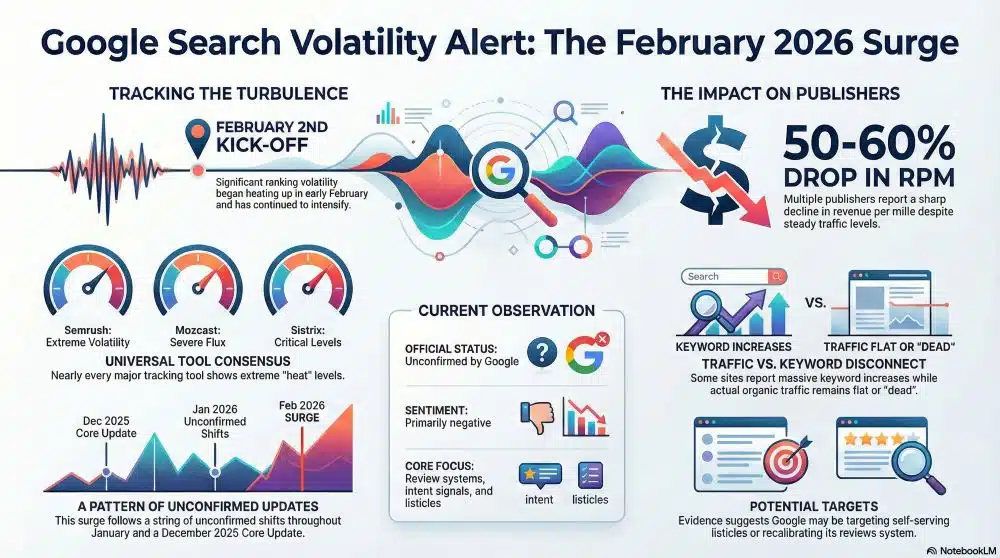
Google Search is showing unusually high ranking volatility again, and this time it feels more intense than a typical “weekend shuffle.” Based on the latest reporting and the broader pattern of volatility through late January and early February, we’re likely looking at a mix of unconfirmed algorithm adjustments plus continued rollout and recalibration tied to AI-driven search features.
Even without an official announcement from Google, the SEO community is seeing consistent signs: sharp ranking swings, unstable visibility, unpredictable traffic drops, and major fluctuations across verticals.
This article breaks down what’s happening, what real site owners are experiencing, what patterns are emerging, and what SEO teams should do next.
What’s Happening Right Now in Google Rankings
Rankings Are “Heated” Again (Feb 2–4, 2026)
Multiple SEO tracking tools and community chatter indicate a strong spike in ranking changes around February 2, 2026, with volatility continuing into the following days.
This isn’t just minor turbulence. It resembles the type of movement typically associated with:
Broad algorithm tuning
Quality system recalibration
Search layout changes
AI Overview expansion
SERP experimentation
Google has not confirmed a core update during this time, but this kind of volatility does not usually happen without meaningful ranking system adjustments.
Why This Volatility Matters More Than Normal
Ranking volatility is common in Google. The difference right now is:
It’s impacting publishers and e-commerce sites simultaneously
It aligns with ongoing AI changes in the SERPs
When volatility hits multiple Google surfaces at once, it often indicates the ranking systems are being adjusted in a way that affects how Google decides what deserves exposure, not just how pages reorder in blue links.
What Site Owners Are Reporting
To make this report more educational, it’s worth including what real site owners are seeing. These are not “light” complaints — some are describing catastrophic loss events.
A Publisher Reporting a 95% Collapse Since December
One publisher described a long-term collapse that began around December 12, with traffic falling from 50,000 clicks per day down to around 40 clicks per day.
What makes this especially alarming is the scope of the loss:
Search visibility collapsed
Google Images traffic disappeared
Google News visibility disappeared
Google Discover visibility disappeared
Rankings appear “unchanged” for tracked terms, yet impressions are gone
This is a critical detail. It suggests that what’s happening may not simply be “ranking down,” but potentially:
a site-wide suppression
a visibility dampening system
a platform distribution issue (News/Discover eligibility loss)
or a deeper quality classifier hit
In plain English: some publishers are reporting they were essentially removed from discovery systems, not just moved down a few positions.
Google News Indexing Can Become a Hidden Bottleneck
Another key observation from the discussion: some sites still get indexed quickly, but their articles appear on the last pages of Google News results.
That matters because:
Discover visibility often correlates with strong News indexing
News placement affects how quickly a site regains momentum
Being indexed “fast” does not mean being “distributed”
This is one of the most overlooked truths in 2026 SEO: indexing is not the same as visibility.
Some SEOs Say the SERPs Are Getting “Worse”
Other comments reflect a different frustration: the perception that Google is rewarding low-quality, AI-generated, or even fraudulent sites, while burying legitimate publishers.
Several themes show up repeatedly:
“We follow all the rules and still lose visibility.”
“Fraudulent or imposter sites are ranking on page one.”
“Competitors with junk backlink profiles are outranking real content.”
“AI content is winning because it matches Google’s preferred formatting.”
Whether or not every claim is objectively true, the sentiment is important: trust in ranking fairness is eroding, and that impacts how publishers invest in content.
The Most Likely Explanation: This Volatility Is AI-Driven
A large portion of the discussion suggests the volatility is strongly correlated with Google expanding and testing AI Overviews (AIO) and possibly preparing for broader adoption of AI Mode.
While we can’t prove a direct causal link without Google confirmation, the logic is reasonable:
AIO placement changes click distribution
AIO can reduce organic CTR even when rankings stay stable
AIO can suppress entire categories of informational traffic
Google may be recalibrating what content gets cited in AIO
This lines up with broader reporting that AI Overviews can significantly impact click behavior when present.
What This Means for SEO in 2026
Rankings Alone Are No Longer the Whole Game
In 2026, you can rank #1 and still lose traffic if:
AI Overviews answer the query before the click
the SERP is filled with widgets, videos, and shopping modules
your result is pushed below the fold
Google chooses not to cite you in AI-generated answers
This is why AEO (Answer Engine Optimization) is no longer optional.
AEO Insight: Google Is Training Users Away From Blue Links
One of the smartest points raised in the comments is this:
Google is conditioning users to treat AI answers as the “main result,” and blue links as secondary.
That aligns with how SERPs now behave:
AI Overviews appear above traditional results
Organic results often become “supporting sources”
Search becomes a summary engine rather than a discovery engine
For publishers, this changes the business model dramatically.
The New SEO Reality: Google Can Reduce Your Traffic Without Moving Your Rankings
This is the part that breaks a lot of traditional SEO thinking.
A publisher can report:
“My rankings are the same.”
“My traffic is gone.”
“My impressions collapsed.”
That can happen when:
AI Overviews take clicks
Google reduces Discover distribution
Google News positioning changes
SERP layout pushes organic down
Google reinterprets query intent
So if you’re auditing a site during volatility, you must look at:
impressions and CTR
SERP feature presence
AIO visibility
Discover and News performance
query-level intent shifts
What Google May Be Targeting Right Now
Based on the broader reporting around this volatility period, there are a few plausible targets.
Self-Promotional Listicles and Low-Value “Best Of” Pages
There has been reporting suggesting Google may be pushing down self-promotional listicles and low-value roundup pages during recent unconfirmed updates.
That doesn’t mean “listicles are dead,” but it does mean:
listicles without unique insight are at risk
affiliate-heavy roundups may get suppressed
generic “top 10” content is more volatile
Thin Content That Exists Only to Rank
Pages that exist purely for keyword capture (without depth, original analysis, or unique expertise) are increasingly unstable.
This is especially true now that AI systems can generate “average” explanations instantly.
Sites That Lost Trust in News/Discover Systems
For publishers, being pushed to the bottom of Google News can effectively remove them from Discover, and Discover loss can permanently reduce traffic even if Search remains stable.
What To Do Right Now (Practical SEO + AEO Checklist)
Step 1: Do Not Panic-Edit Your Site
During volatility, the worst move is rewriting everything at once.
Instead:
document what changed
compare winners vs losers
wait 7–14 days before major structural changes
Step 2: Identify Which Pages Lost Clicks vs Which Lost Rankings
This matters because:
ranking loss = relevance/authority issue
click loss with stable ranking = AIO/CTR/intent issue
Step 3: Add AEO Blocks to Priority Pages
If you want AI engines to cite your content, build content that’s easy to extract.
AEO blocks should include:
short direct answers (40–60 words)
bullet lists
tables
FAQ schema
clear headings
definitions and comparisons
Step 4: Strengthen Brand Signals
This is not fluffy advice. In AI search, Google needs strong confidence signals.
Focus on:
author transparency
About page credibility
citations and references
consistent topical coverage
real-world proof (photos, case studies, data)
Step 5: Diversify Traffic Sources
If your business depends on SEO traffic alone, you are exposed.
Publishers and service businesses should push:
email lists
YouTube and short-form video
local SEO + GBP
referral partnerships
social distribution
paid search for high-value queries
Key Takeaway: This Isn’t Just Volatility — It’s a Search Model Shift
This current “heated” volatility isn’t only about rankings. It’s about Google changing:
how it displays information
what it considers a “result”
how much traffic it sends out
how AI-generated answers replace clicks
That’s why so many publishers feel like the ground is moving under them. In many ways, it is.
FAQ: Google Ranking Volatility + AI Overviews (2026)
What is Google ranking volatility?
Google ranking volatility refers to significant changes in search result positions across many keywords and industries over a short period of time. High volatility usually indicates algorithm adjustments or major SERP changes.
Is Google running a core update right now?
Google has not officially confirmed a core update during this specific volatility period. However, the scale and duration of movement resemble patterns seen during major algorithm changes.
Why do rankings stay the same but traffic drops?
This can happen when Google changes the search layout or adds AI Overviews that answer the query without requiring a click. It can also happen if CTR drops due to SERP features.
Are AI Overviews reducing organic traffic?
Yes, multiple analyses suggest AI Overviews can reduce click-through rates by providing answers directly in the SERP, reducing the need to visit websites.
Why did my Discover traffic disappear?
Discover traffic can drop if Google reduces distribution, changes eligibility, or reclassifies content quality signals. Discover is also heavily influenced by engagement and topical authority.
Can a site lose Google News visibility and Discover at the same time?
Yes. Many publishers report that losing strong Google News placement often correlates with reduced Discover visibility, since both systems rely on similar freshness and quality signals.
Is this volatility affecting only publishers?
No. While publishers are often hit hardest, e-commerce and service-based sites can also see volatility, especially when AI Overviews expand into transactional or commercial queries.
What should I do during a volatility spike?
Avoid drastic site-wide changes. Instead:
monitor daily trends
audit which page types lost visibility
compare SERP layouts
strengthen content structure and AEO blocks
How do I optimize for AEO in 2026?
AEO (Answer Engine Optimization) focuses on structuring content so AI systems can extract and cite it easily. This includes:
direct answers
FAQ sections
structured headings
schema markup
tables and summaries
How long does volatility usually last?
It varies. Some volatility resolves in days, while larger system shifts can take weeks. AI-driven SERP changes may create ongoing instability because Google continues testing and expanding features.
David Montalvo is a senior SEO strategist and Founder of UnReal Web Marketing, with over 25 years of experience in SEO, PPC, and full-funnel digital marketing. Over the past two decades, his SEO initiatives have generated more than $650 million in incremental organic revenue, helping brands turn search visibility into measurable business growth. He has also worked with multiple Fortune 500 companies across a wide range of industries.
David’s client portfolio includes Mayo Clinic, Merrill Lynch (UK Division), Cardinal Health, JetBlue, Goodyear, Apple Bank, Jet Direct Mortgage, MLS, Morrell Instruments, Molloy Bros Moving, JD Funding, National Business Capital, Steinway Pianos, Yamaha, Hearst Publishing, Benzinga, ISOPURE, Construction Executive Magazine, Loomis Sayles, Mindray North America, BOMImed, SightMD, IRIS Software, Datascan Software, Globecomm, Hestan, One Way Furniture, RSS Staffing, Daniel Gale, Scott Cooper, Wholesale Chef Store, Admiral Craft, WindowRama, Ocean Air, Heller Tax Grievance, Propane Depot, Redefine Fitness, Grainger, LabSafety, Autoscope, the U.S. General Services Administration (GSA), and the State of Connecticut.
In addition to his client and enterprise work, David is a sought-after keynote speaker, regularly sharing advanced insights on SEO strategy, AI-driven search, and digital performance marketing with audiences nationwide.
In the ever-shifting world of SEO, few things stay the same. Algorithms evolve, user expectations rise, and yesterday’s best practices collect dust. But through it all, one principle holds firm: user experience isn’t optional—it’s essential. And in 2025, Google’s Core Web Vitals (CWV) remains front and center in that conversation.
What Are Core Web Vitals—And Why Do They Matter?
Search engines used to judge websites mostly by what was on the page—keywords, backlinks, metadata. But in 2020, Google changed the game with Core Web Vitals (CWV), shifting part of the spotlight from content to experience. These vitals aren’t about how relevant your content is—they’re about how it feels to use your site.
CWV focuses on three real-world performance metrics that reflect what visitors care about most: how fast your page loads, how quickly it responds, and whether it behaves the way they expect.
1. Largest Contentful Paint (LCP): Loading Performance
What it measures: The time it takes for the main, visible content (usually a hero image or headline) to load.
Target: Under 2.5 seconds.
Why it matters: If it takes too long to see something useful on the screen, users get frustrated or abandon the page entirely. LCP is about delivering value fast.
2. First Input Delay (FID): Interactivity
What it measures: The time between when a user clicks or taps something (like a link or button) and when the site responds.
Target: Under 100 milliseconds.
What’s changing: In 2025, FID is being replaced by INP (Interaction to Next Paint), a more comprehensive measure that looks at all interactions on a page, not just the first one.
Why it matters: Even if your site looks great, a laggy button or unresponsive navigation kills the user experience—and credibility.
What it measures: How much content “shifts” as the page loads—think of buttons jumping around, text sliding down, or banners pushing things out of place.
Target: A score under 0.1.
Why it matters: Users expect a stable, predictable layout. Unexpected shifts lead to misclicks, confusion, and poor impressions—especially on mobile.
Core Web Vitals in 2025: Where We Stand
Fast-forward to today, and CWV has gone from “recommended reading” to a core part of SEO strategy. With mobile traffic dominating and 5G reducing user patience to seconds, expectations have skyrocketed. A slow or jittery site isn’t just frustrating—it’s bad for business.
Google’s recent updates now factor INP (Interaction to Next Paint) more prominently, replacing FID as a more comprehensive measure of interactivity. Unlike FID, which only measures the first interaction, INP tracks how long it takes your site to respond to all interactions throughout the session. It’s a more realistic picture of what the user actually experiences.
How Smart Businesses Are Meeting the Moment
Meeting CWV standards takes more than minor tweaks—it often requires rethinking how your site is built. Here’s what top-performing sites are doing:
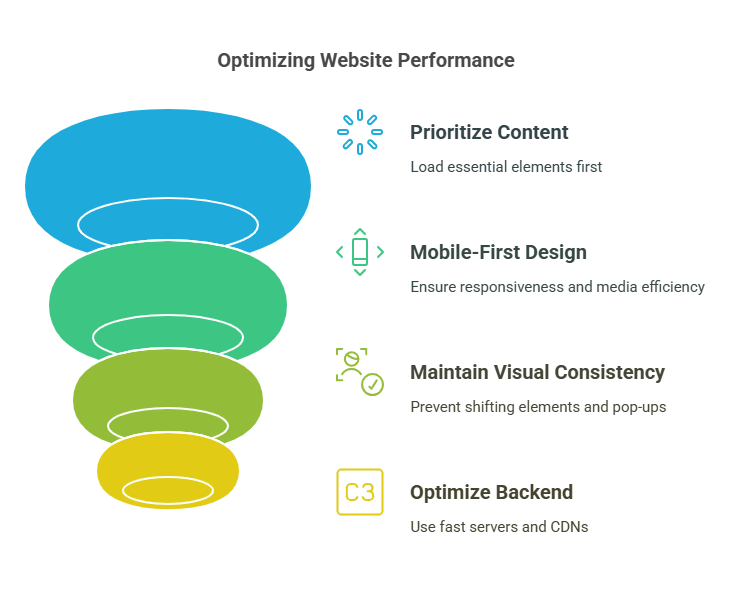
Load What Matters First: Prioritized content loading ensures users see meaningful content within seconds. Techniques like lazy loading and server-side rendering help streamline the process.
Mobile-First Design: With over 60% of search traffic coming from mobile devices, responsive design, optimized media, and mobile-specific layout considerations are now standard.
Visual Stability Over Flashy Features: Minimizing layout shifts means reducing disruptive elements like auto-resizing banners, pop-ups, and delayed-loading ads.
Backend Efficiency: Tools like Lighthouse and PageSpeed Insights help pinpoint bottlenecks. Improvements like using next-gen image formats (WebP, AVIF), compressing files, and leveraging CDNs all play a role.
Why Core Web Vitals Go Beyond Rankings
It’s tempting to view CWV as just another SEO checkbox. But improving CWV metrics doesn’t just help your rankings—it helps your bottom line.
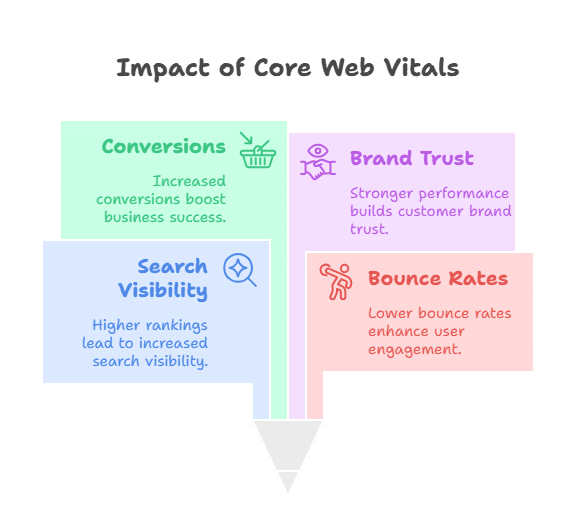
Higher Engagement: Faster load times and smoother interactions keep visitors on your site longer.
Lower Bounce Rates: A stable, responsive page reduces the frustration that sends users back to search results.
Increased Conversions: Studies have shown that even a one-second delay in page load can drop conversion rates by 7% or more. In e-commerce, that can be a six-figure problem.
Brand Perception: A fast, stable site communicates professionalism and builds trust—especially with B2B buyers doing pre-purchase research.
Where Many Companies Struggle
Despite the clear benefits, many companies struggle to bring their CWV scores into Google’s “good” range. Older websites with bloated code, outdated plugins, or non-responsive design often need significant overhauls—not just a few line edits. Even newer sites can run into problems if they’re overloaded with animations, third-party scripts, or unoptimized media.
This is where working with a seasoned partner makes a difference.
How UnReal Web Marketing Helps
Optimizing for CWV isn’t just about technical fixes—it’s about aligning your entire digital strategy with performance and user satisfaction. That’s where UnReal Web Marketing can step in.
Our team helps businesses identify what’s slowing them down, what’s disrupting their layout, and where they’re falling short on interactivity. From conducting a full CWV audit to rebuilding templates and deploying mobile-first experiences, we take a strategic approach to performance that supports both SEO goals and conversion goals.
But it doesn’t stop at optimization. We help businesses automate performance monitoring and adjust in real time. With advanced analytics, A/B testing, and smart segmentation tools, we ensure your site evolves alongside the expectations of your audience—and the ever-changing rules of the search engine game.
The Future of SEO Is Experience-First
Core Web Vitals are just one piece of a larger puzzle. In 2025, SEO is increasingly tied to user signals—things like dwell time, bounce rates, and even brand mentions. Google is looking for sites that don’t just show up, but actually serve people well.
That shift opens up opportunities for smaller businesses and newcomers to leapfrog over bigger players by simply doing the basics right: speed, usability, and relevance. In this new SEO era, success isn’t reserved for the company with the most backlinks—it’s available to any brand that puts users first.
Whether you’re just starting your optimization journey or trying to get past that last stubborn CWV metric, you’re not in it alone. Partnering with an experienced team like UnReal Web Marketing can help you meet the moment—and stay ahead of whatever comes next.
In the early days of the internet, web design was largely about appearances. If your site looked professional, that was enough to build trust. But in 2025, effective web design is about far more than aesthetics—it’s about how a website feels to use. It’s about speed, clarity, accessibility, and purpose. Modern users don’t just visit websites—they interact with them, and they expect that interaction to be effortless.
User Experience Drives Everything
Today’s users have no patience for clunky websites. They expect a page to load in under two seconds, they want to know exactly where to click, and they’ll bounce if anything feels awkward, confusing, or slow. This is why user experience (UX) has become the single most important factor in successful web design.
UX isn’t just about button placement or mobile responsiveness—it’s about understanding how users think and behave. It’s anticipating their needs, eliminating friction, and making it easy for them to find what they’re looking for. That includes:
Clear navigation: Users should be able to reach any key page on your site in just a few clicks—ideally two or less.
Consistent layout and design cues: Fonts, colors, and spacing need to feel cohesive to build trust and reduce cognitive load.
Intuitive hierarchy: The most important content should stand out immediately. Headlines, CTAs, and key visuals must lead the user’s eye through the page.
Inclusive design: Accessibility features like alt text, proper contrast ratios, and keyboard navigation aren’t just nice to have—they’re essential for reaching all audiences.
At Unreal Web Marketing, we view UX as a shared space between function and feeling. If a site is technically solid but emotionally disconnected, it won’t resonate. We build experiences that are both user-friendly and human-friendly.
Responsive Design—And Then Some
Mobile-first design is now the standard, not the exception. With over 60% of all web traffic coming from mobile devices, your site needs to be more than just responsive—it needs to be optimized for mobile behavior.
That means:
Prioritizing thumb-friendly navigation
Minimizing clutter
Reducing load times on slower connections
Delivering critical content first
We don’t just resize your desktop site for smaller screens—we design with mobile intent in mind from the very beginning.
Core Web Vitals: The UX-SEO Connection
Google’s Core Web Vitals—Largest Contentful Paint (LCP), Interaction to Next Paint (INP), and Cumulative Layout Shift (CLS)—aren’t abstract developer jargon. They’re hard metrics that measure how users experience your site in real life. If your site loads slowly, lags during interactions, or jumps around while loading, users get frustrated—and so does Google’s ranking algorithm.
Modern web design must now incorporate technical performance into its foundation:
Fast-loading images and videos
Streamlined code
Smart use of caching and CDNs
Stable layout structure that prevents unexpected shifts
These optimizations improve rankings and create a more enjoyable experience for your visitors.
Conversion-Ready From Day One
Great design isn’t just about aesthetics—it’s about action. Every design element on your site should lead users toward a specific goal: making a purchase, filling out a form, signing up for a webinar, or contacting your team.
We design with conversions in mind by:
Using clear, compelling CTAs that stand out without overwhelming
Placing forms and buttons exactly where users expect them
Crafting headlines that speak directly to your audience’s pain points or goals
Supporting content with visuals that inform and inspire—not distract
A great UX gently guides the visitor through your funnel without making them think too hard. That’s the sweet spot.
Future-Proofing Your Digital Presence
The web evolves fast—and your website should too. In 2025, AI-generated content, voice search, privacy regulations, and new user behaviors are changing how people browse and buy. Your website needs to be flexible, scalable, and ready for what’s next.
We future-proof your site by:
Using modular designs that can grow with your business
Choosing platforms and CMS options that support ongoing content strategy
Building in analytics tools to measure real behavior and optimize accordingly
The result? A website that evolves with your business, not one that holds you back.
Looking for a Website That Works as Hard as You Do?
Web design in 2025 is no longer about checking boxes or following trends. It’s about building a site that performs, persuades, and lasts. At Unreal Web Marketing, we design websites that don’t just look good—they work hard, delivering the experience today’s users expect and tomorrow’s technology demands.
Let’s build something smarter together.Reach out to start a conversation about redesigning or upgrading your digital presence.
In a digital landscape where SEO can take months and organic social media reach is on life support, Pay-Per-Click (PPC) advertising remains one of the fastest, most reliable ways to generate leads, grow brand visibility, and increase revenue—without waiting around for momentum to build.
Whether you’re trying to get in front of local buyers or a global B2B audience, PPC delivers precision, speed, and scalability unmatched by other marketing channels.
PPC Has Evolved (and Gotten Smarter)
PPC in 2025 is not what it was five years ago. The platforms are smarter, the competition is tighter, and the stakes are higher. Google Ads and Microsoft Ads now use AI-powered bidding, real-time search intent signals, and predictive modeling to improve campaign performance automatically.
But here’s the catch: AI can do the heavy lifting—but it can’t do the thinking for you. That’s where Unreal Web Marketing comes in. We leverage automation tools for efficiency, but we pair them with human insight to make sure every campaign aligns with your audience, goals, and brand voice.
We build strategic ad funnels—not just keyword lists—so you’re not just showing up in search results, you’re showing up with the right message at the right moment.
Hyper-Targeted Campaigns for Maximum ROI
The magic of PPC lies in its ability to reach people who are actively looking for your product or service. And in 2025, targeting goes far beyond keywords. With robust audience segmentation, we can filter traffic by:
Demographics (age, gender, income level)
Location and time of day
Device type
Past behavior (e.g., site visitors or cart abandoners)
Purchase intent
Industry or job title (for B2B campaigns)
This level of targeting helps eliminate wasted ad spend and ensures your budget goes toward the people most likely to convert.
Creative Still Counts: Ads That Actually Get Clicks
Even the most sophisticated targeting won’t matter if your ad copy falls flat. Great PPC creative grabs attention, teases value, and gives the user a reason to click now—not later.
We craft ads that are:
Clear and benefits-driven
Aligned with the user’s intent
Consistent with your landing page messaging
Optimized with relevant sitelinks, callouts, and structured snippets
And with video ads, display banners, shopping feeds, and native ad formats continuing to grow in importance, our creative team helps you make a lasting impression wherever your audience scrolls, clicks, or watches.
Why PPC Is Cost-Effective (When Done Right)
PPC isn’t about buying clicks—it’s about buying outcomes. Every dollar you spend should be traceable to a result: a lead, a sale, a booked appointment. That’s why we focus not just on traffic, but quality traffic that’s ready to convert.
Here’s how we protect your ROI:
Custom landing pages built for conversions
A/B testing for ad variations and messaging
Conversion tracking tied directly to your CRM or e-commerce platform
Bid adjustments to prioritize high-performing audiences or times of day
This level of detail ensures we’re not just generating activity—we’re generating revenue.
PPC + SEO = The Smartest Long-Term Play
SEO and PPC shouldn’t be in separate silos—they should inform each other. We use PPC data to discover high-converting keywords, test messaging, and uncover user behavior trends. Then, we use those insights to shape your SEO content strategy for long-term visibility.
PPC gives you the instant feedback loop SEO can’t match. SEO builds the trust and authority PPC can’t buy. Together, they create a marketing flywheel that compounds over time.
Advanced Reporting That Makes Sense
We believe clients should understand exactly how their campaigns are performing—without having to decipher a spreadsheet jungle. Unreal Web Marketing delivers easy-to-understand reports that focus on what matters:
Cost per lead (CPL)
Return on ad spend (ROAS)
Conversion rate trends
Keyword-level performance
Demographic and device insights
We meet with you regularly to review, adjust, and grow—not just to hand you numbers.
The Bottom Line: Let Your Ad Spend Work Harder
PPC is one of the most measurable and scalable marketing investments available—but only when it’s done with precision. If you’re running ads without a clear strategy—or not running them at all—you’re likely leaving leads, sales, and profit on the table.
UnReal Web Marketing delivers high-performance PPC campaigns that attract the right audience with the right message—at exactly the right time. Let’s talk about how we can help you get more qualified leads and better results.
There are few constants in the ever-evolving landscape of Search Engine Optimization (SEO). Algorithms change, user behaviors shift, and best practices evolve. However, the centrality of user experience in SEO strategies is one theme that remains consistent. As we move through 2023, one of the most talked-about topics in the SEO community is Google’s Core Web Vitals (CWV) initiative.
Understanding Core Web Vitals
Launched in 2020, Core Web Vitals is a set of metrics designed by Google to gauge the user experience on a webpage. These metrics measure real-world, user-centered outcomes and give business owners and web developers tangible targets for performance optimization. The three main components of CWV are:
Largest Contentful Paint (LCP): Measures loading performance. Ideally, a page should have an LCP of 2.5 seconds or faster.
First Input Delay (FID): Assesses interactivity. Pages should strive for an FID of less than 100 milliseconds.
Cumulative Layout Shift (CLS): Evaluates visual stability. The ideal score is less than 0.1.
Why has there been such emphasis on these metrics? It’s simple: Google believes that if users have a superior experience on a website, they’re more likely to stay engaged, consume content, and return in the future.
The 2023 Landscape of Core Web Vitals
Fast forward to 2023, and Core Web Vitals have evolved from being just another set of metrics to being integral to SEO strategies. With Google confirming CWV as a ranking factor, businesses have been propelled into action, re-assessing and re-engineering their websites to meet these benchmarks.
Moreover, with the rise of mobile browsing and 5G technology, users now expect faster and smoother online experiences than ever before. Websites that fail to adapt to these evolving expectations risk falling behind in search rankings, user trust, and brand reputation.
Integrating CWV into SEO Strategies
SEO professionals have always understood the importance of speed and user experience. However, with CWV, there’s a newfound focus on ensuring that optimization efforts cater to these specific metrics. Here’s how businesses are integrating CWV into their SEO approach:
Prioritized Content Loading: Websites are now designed to load primary content first, ensuring users see the most relevant information immediately.
Enhanced Mobile Experience: Most web searches are now conducted on mobile devices, and optimizing for mobile has never been more critical. Techniques such as responsive design, AMP (Accelerated Mobile Pages), and optimizing media files have become standard.
Stability Over Flashiness: While interactive designs and animations can make a site attractive, they can also lead to layout shifts. Web designers now balance aesthetics with stability, ensuring visual elements don’t impede user experience.
Challenges and Opportunities
However, while there is a clear roadmap for businesses to enhance their CWV scores, the journey isn’t devoid of challenges. Many legacy systems and larger websites with vast content find it hard to adapt swiftly. On the other hand, newer or recently updated websites might find it easier to tweak their designs and backend infrastructure to meet CWV requirements.
This disparity presents an opportunity for SEO professionals and web designers. As businesses vie for top search rankings, there’s a burgeoning demand for experts to help redesign and optimize websites to meet CWV standards.
The Shift Toward User Experience
The focus on Core Web Vitals in 2023 underscores a broader shift in SEO’s world: the shift towards genuine user experience. Instead of optimizing solely for machines or algorithms, businesses now recognize the value of optimizing for the end-user.
While challenges persist, the emphasis on CWV has, in many ways, leveled the playing field. No longer can large companies rely solely on solid backlink profiles or high domain authority. Instead, the metric of success has become how well a website serves its users. In this new paradigm, small businesses and new entrants have as much a chance to succeed as established players as long as they prioritize user experience above all else.
Research shows 94% of first impressions relate to your site’s web design.
You may have a great product, but the first element of interaction with your potential customer is your website. If you don’t make a good first impression with your web design because your site is outdated or unappealing, chances are potential customers will bounce off your website and find your competitor. To positively impact your site visitors, invest in a fresh redesign that catches your audience’s attention and gets them to engage on your page.
2. Are You Mobile-Friendly?
According to Statista, by 2024, there will be more than 185 million mobile buyers.
That is a lot of traffic and a lot of sales you will miss out on if your site isn’t mobile-friendly. Who doesn’t have a smartphone nowadays? Providing a mobile-friendly website reduces bounce rates by making it easy for visitors to navigate your site using their cell phones.
3. In Website Traffic, Speed Is a Good Thing.
According to a study by Google, the fastest websites can load within five seconds and retain 95% of their visitors.
The longer it takes your site to load once someone clicks on it, the more you’ll lose out on some potential customers who give up due to your slow site speed. Make sure your website is optimized for speed to keep traffic moving on your site and not your competitors.
4. Is Everything Neat and in Order?
53% of all trackable website traffic comes from organic search. (BrightEdge)
Optimizing your content for search engines is very important. On-page SEO is the practice of optimizing web page content for search engines. If you show up on page 1 of the SERP, you’re more likely to get more traffic to your website. On-page SEO practices include:
Optimizing title and meta tags.
Developing keyword-rich content.
Creating internal links.
Assigning SEO-friendly URLs to your web pages.
5. What’s Going on Behind the Scenes?
68% of online experiences begin with a search engine. (Intergrowth)
A little schema goes a long way. Schema is a type of microdata that makes it easier for search engines to interpret the information on your web pages more effectively to serve relevant results to users based on search queries. While Google claims that schema does not affect search ranking factors, it does improve your site’s rich snippets. Rich snippets help people find what they want, and that is what Google loves. If you are more visible in the search engines on page 1, you will get more website traffic.
6. Do You Know How To Tell a Good Story?
B2B marketers use an average of 13 content marketing tactics. (TopRankBlog)
You can’t just rely on one type of content for your website. Don’t be afraid to vary the length and format you use, interspersing short news-based blog posts with longer pieces such as video, infographics, or data-driven articles. Creating quality copy without sounding robotic can be challenging but is extremely valuable in bringing quality traffic to your website. Don’t forget an excellent, compelling headline either because, without a powerful, attention-grabbing headline, even the best-written articles may go unread.
7. Are You Short Tail or Long Tail?
Long-tail keyword searches have a click-through rate of 3% to 5% higher than generic searches. (Smart Insights)
Long-tailed keywords are good if you’re in a competitive market. For example, the keyword “lawyers” produces over 201,000 searches per month. A long-tail keyword for lawyers could be “divorce lawyers near me,” which produces 110,000 per month. “Divorce attorney near me” creates 40,500 searches per month. Long-tail keywords can have a higher conversion value, as they are more specific. The traffic growth may be more gradual, but it opens you up to new visitors who are more motivated to buy.
8. If a Picture Is Worth a Thousand Words, How Much Is a Video Worth?
Video is 50x more likely to get organic ranking than plain text results. (Forrester)
When it comes to attracting new customers, video content combines visual imagery and sound to tell your story better than static images or text. Studies show that information retention is significantly higher for visual material than it is for text. So, if you want to boost traffic to your website, add video content. According to Elite Content Marketer, 66% of people said they’d prefer to watch a short video to learn about a product or service. 18% would rather read a text-based article, website, or post.
9. Are You Social?
53.6% of the world’s population uses social media. The average daily usage is 2 hours and 25 minutes. (Global Webindex)
Maintaining an active presence on popular social channels such as Twitter, YouTube, Facebook or Instagram can help you increase traffic to your website by leveraging the power of people sharing and liking your posted content – this builds awareness for any business’ products while simultaneously boosting traffic from sources like Google search results. Be sure to post regularly and offer relevant content that your ideal customers will find helpful, including images, videos, infographics, how-to guides, and more.
Make sure your social media profile is optimized. Fill in all the details on your profile and include relevant keywords. Also, add your website links in your social media profile and add your social media links on your website as well.
10. Thought Leaders Get More Traffic.
More than half (55%) of business decision-makers said they had increased their business with an organization based on their thought leadership. (LinkedIn)
Becoming an industry thought leader certainly is not easy. It requires maintaining an active role in providing fresh content and participating in industry events. Creating a blog with valuable, insightful information can help give you industry thought leader status, setting you apart from your competition and bringing potential customers to your website to read your content and procure your products and services.
11. Link-Up
91% of all pages never get any organic traffic from Google, mostly due to the fact they don’t have backlinks. (Ahrefs)
A backlink is a link from one website to another. Backlinks help websites increase their search traffic and rankings on search engines. But only high-quality backlinks will actually increase your website traffic. Backlinks are significant ranking factors. Google considers incoming links as a “vote of confidence” from one site to another. So, the more backlinks a page has, the more search traffic it gets from Google.
Referral traffic refers to visits to your site from links that appear on a different site. To make referral traffic worth your while, it has to be from a site that is reputable with ongoing traffic itself; otherwise, you could get penalized by Google. The best links that bring in quality referral traffic include directory/resource links, review links, and news aggregator links.
12. Does It Pay To Advertise?
Global digital ad spend will reach $445 billion in 2021. (eMarketer)
Paid search, social media advertising, and display ads help drive relevant traffic back to a business’ website.
Paid search involves placing ads on Google and other major search engines, which can lead you down the path towards success in no time! With paid search ads, businesses bid on ad placement to appear as a sponsored link on the search engine results page. When search engine users search for relevant keywords related to the company, the PPC ad will appear at the top of the page in their search query. The ad usually includes a link back to the sponsor’s website, which brings in the traffic that turns prospects into customers. Google estimates that businesses generally make an average of $2 in revenue for every $1 they spend on AdWords.
Social media advertising involves placing ads on social networking sites with a link back to your site to bring in more traffic, create brand awareness, and sell products. Promoted ads on Facebook, Twitter, or Linkedin are an effective way to target the right audience and get even better results than organic. In addition, everything is tracked, and you can use the data to improve your advertising campaigns further.
Display ads appear on Internet websites, apps, or social media through banners made of text, images, flash, video, and audio and can include a link back to your website to drive more traffic. According to Zenith forecast: Total display ad spend is expected to hit $177.6 billion globally. You can use retargeting tactics on your website to serve visitors display ads once they leave your site and visit other sites.
13. Get Gold Stars
Studies show that 94% of consumers report that positive reviews make them more likely to use a business.
Online reviews allow customers to rate their experience with a company and potential customers to decide whether they trust that company. As a result, online reviews have a significant impact on increasing a website’s traffic. If your customers have a positive experience with your company, encourage them to offer a review on sites like Yelp, Trip Advisor, and Google.
14. Can You Teach Them Something They Don’t Know?
Webinars hosted on a company domain generate 3x more audience participation. 91% of professionals who watch webinars say their next step is to visit a website for more info. (BrightTALK)
Webinars and live events are a great way to share your wisdom with eager audiences and bring in qualified traffic interested in learning about trending topics, case studies, and demonstrations around your products and services. Send out an email ahead of time so that you can increase attendance and promote through social media. Make sure your webinars are informative and not salesy if you want to hold your audience’s attention.
15. If You Email, They Will Come.
49% of consumers said that they would like to receive promotional emails from their favorite brands on a weekly basis. (Statista)
Email marketing is a powerful tool to help send traffic to your website. In fact, you’re 6x more likely to get traffic from emails than from tweets. Email newsletters can drive subscribers to your website to read an article or take advantage of an offer. Promotional emails can focus on specific sales or events, such as a product demonstration or featured artist in your store.
Remember to include CTAs with linkbacks to your website. Use Google Analytics to see how much traffic is coming through to the site when you send emails by adding UTMs (Urchin Tracking Module) to your links.
The top four ranking factors are direct website visits, time on site, pages per session, and bounce rate. (SEMrush)
Google Analytics is your best friend on just about every conceivable aspect of your site, from your most popular pages to visitor demographics. Review what pages and posts are the most popular. Inspect visitor data to see how, when, and where your site traffic is coming from. Analyze the data and use this information to inform your marketing and content strategies.
Getting To Where You Want To Go
Driving traffic to your website is challenging, but with effort will be rewarding. Following the 16 tactics above will help get you more traffic, more conversions, and ultimately increased ROI.